


A New Voice in the Pines: Spotlight on Dr. Lauren Pharr and the Future of RCW Research
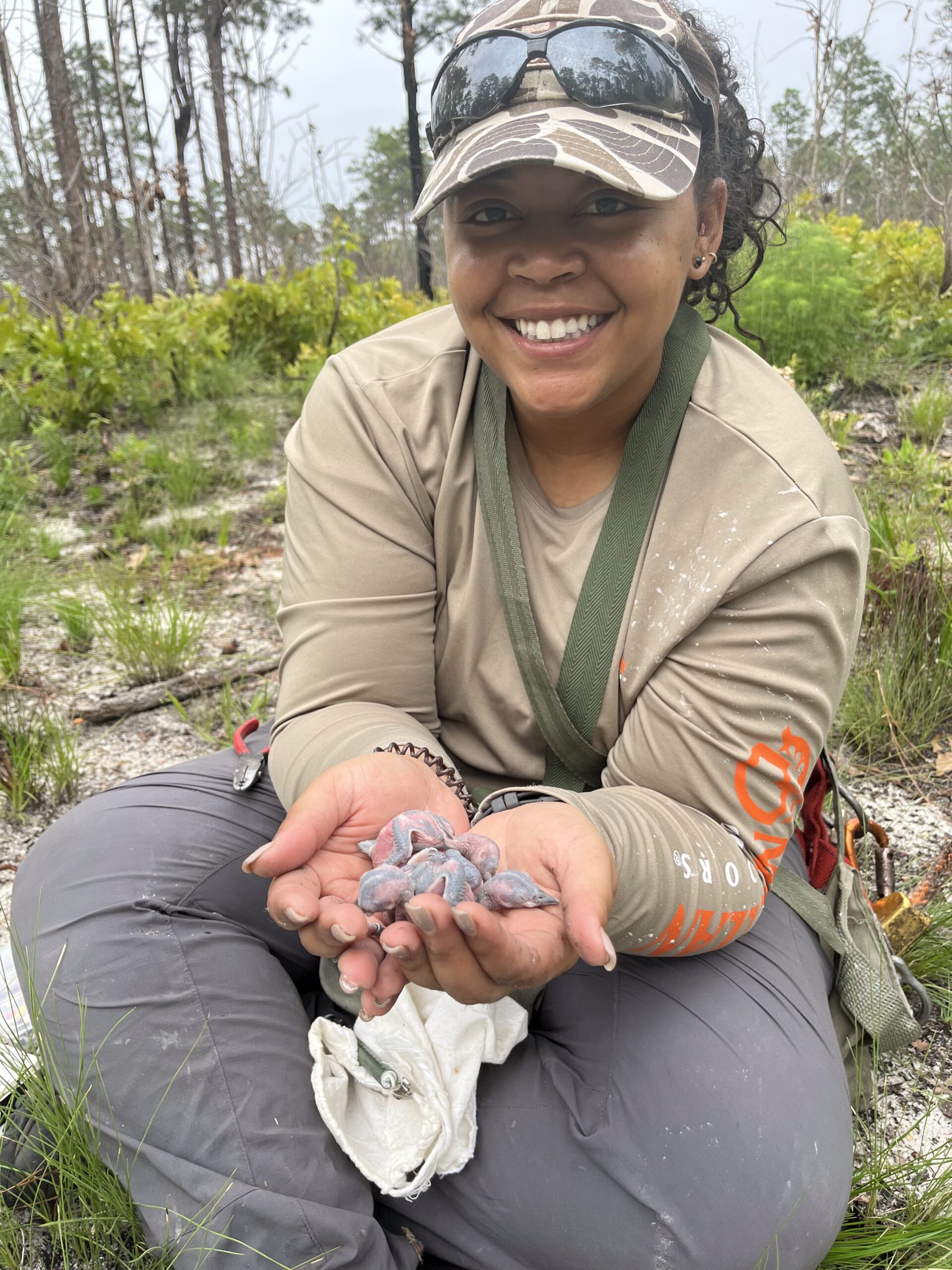
As our year-long journey with the Red-cockaded Woodpecker comes to a close, we offer one final spotlight to celebrate both the species and the people devoted to its future. For our last entry of the year, we’re turning our attention to Dr. Lauren Pharr, a newly minted Ph.D. whose work sheds fresh light on the RCW.
Dr. Lauren D. Pharr is an avian behavioral ecologist and award-winning science communicator whose work bridges bird behavior, conservation, and inclusion in the outdoors. She holds a Ph.D. in Fisheries, Wildlife, and Conservation Biology from North Carolina State University and co-founded Field Inclusive, a nonprofit supporting marginalized voices in fieldwork and nature. Lauren’s writing has appeared in National Geographic, WIRED, PBS SciNC, and The Nature Conservancy’s Cool Green Science blog. Her leadership and outreach have earned her multiple honors, including the 2023 Governor’s Conservation Achievement Award for Young Conservationist of the Year from the North Carolina Wildlife Federation.
Wake Audubon: What first drew you to study the Red-cockaded Woodpecker, and how did this species become the focus of your doctoral research?
Dr. Pharr: My path to studying RCWs started through academic lineage and a desire to immerse myself in fieldwork. My Ph.D. advisor had been advised by Dr. Jeffrey Walters, a renowned behavioral ecologist and long-time leader in RCW research. When I began exploring potential dissertation projects, I told my advisor that I wanted something truly field-intensive, especially after my master’s plans for fieldwork had shifted unexpectedly.
Jeff is still deeply involved in RCW monitoring in the NC Sandhills and had recently observed a steady rise in partial brood loss across the population. That emerging pattern became the foundation of my dissertation research. The Sandhills were only about an hour and a half from NC State where I was based as a student, making it the perfect blend of accessibility, long-term data, and meaningful conservation relevance. Along with the NC Sandhills, I looked at two other populations, Marine Corps Base Camp Lejeune and Eglin Air Force Base.
And the rest really is history. Over the course of my Ph.D., I became one of the species’ strongest advocates. RCWs have given me not only a scientifically rich study system, but also a platform to highlight both the importance of their conservation and the importance of the work I do as a Black woman in this field. Working with them has shaped my development as a scientist and as an advocate for inclusion in conservation.
Wake Audubon: Please tell us about your doctoral research!
Dr. Pharr: My research focused on understanding why so many Red-cockaded Woodpecker chicks die before fledging, a pattern known as partial brood loss. I studied RCWs across three long-term research sites in North Carolina and Florida, some of the most intensively monitored bird populations in North America, to ask what’s driving these losses. I looked at whether it was competition between neighboring families, climate change, or something happening inside the nest itself.
I found no evidence that higher population density caused brood loss, so crowding wasn’t the culprit. Weather told a more complicated story. In the NC Sandhills, warmer weather after hatching actually helped more chicks survive, but this pattern didn’t hold everywhere. One clear sign of change stood out, though: woodpeckers are laying eggs earlier as the climate warms.
The real breakthrough came when I looked at the chicks themselves. Not all eggs hatch at the same time, meaning some chicks start life bigger and stronger than their siblings. Across all three sites, greater size differences meant a higher chance of death. Weather wasn’t directly killing chicks, but it was exacerbating inequality in the nest. Rainfall, temperature, and timing all influenced which chicks hatched strong and which fell behind.
What I learned is that survival isn’t just about how many neighbors birds have or how hard the weather hits. It’s about the delicate balance within each family: the timing of laying, the conditions they face, and how those forces shape the lives of chicks before they ever take flight.
Wake Audubon: How do you see your findings informing Red-cockaded Woodpecker conservation or management going forward?
Dr. Pharr: My research highlights several ways that conservation practitioners can better understand and anticipate partial brood loss in RCWs, especially as populations continue to recover and environmental conditions shift.
- Density increases from successful recovery are not causing higher brood loss.
By showing that partial brood loss is not density-dependent across three long-term study sites, this work helps managers rule out population density as a primary driver of declining reproductive output. This means that ongoing recovery efforts, which naturally increase density, are unlikely to create unintended negative reproductive consequences. Managers can continue prioritizing population growth and translocations without concern that crowding alone is elevating brood loss.- Climate effects on early brood loss are localized, not uniform.
The limited and site-specific influence of temperature and rainfall suggests that managers should avoid one-size-fits-all assumptions about climate impacts. Instead, site-level monitoring of weather conditions and nest outcomes will be more informative than broad regional predictions. Areas showing early brood loss sensitivity may warrant targeted actions such as ensuring high-quality foraging habitat or reducing other stressors during vulnerable early nest stages.- Late brood loss is shaped by chick condition and within-brood competition.
Identifying within-brood mass variation as the strongest predictor of late partial brood loss offers managers a clear biological mechanism to watch. This study is the first to document late partial brood loss in the species. Weather intensified these size disparities rather than directly causing mortality, meaning that conditions leading to uneven provisioning or food limitation, especially heat, drought, or resource bottlenecks, require attention. Ensuring consistent foraging quality and cavity access for larger groups may help reduce stress during food-limited periods.- Social structure matters, particularly male helper number.
Because helper numbers can buffer or exacerbate vulnerability to environmental stress, maintaining robust group structures is key. This supports management actions that promote stable territories, minimize disturbance during the breeding season, and encourage recruitment into helper roles.- Management should integrate social and environmental monitoring.
Overall, the findings emphasize that partial brood loss is not driven by any single factor but emerges from a combination of weather, social composition, brood dynamics, and habitat context. This supports continued use of long-term monitoring programs that collect integrated data on climate, group composition, breeding outcomes, and habitat conditions.
Wake Audubon: Now that you’ve completed your Ph.D., what’s next for you? Will you continue working with RCWs, or are there other species or questions you’re eager to explore?
Dr. Pharr: Finishing my Ph.D. has solidified my interest in understanding how social and environmental factors shape reproductive success in cooperatively breeding birds. I plan to continue building on this work by pursuing a postdoctoral or faculty position and continue to focus on cooperative breeding, ideally with RCWs as well as other systems such as acorn woodpeckers or Florida scrub-jays. These species offer rich opportunities to explore behavioral ecology, social structure, and climate impacts within long-term study populations, questions that are central to my research trajectory.
While my dissertation has centered on RCWs and I hope to remain connected to that community also, any next steps will broaden my comparative perspective. Many of the questions raised in my RCW work – how group composition buffers environmental stress, how climate shapes early-life survival, and how social behavior interacts with habitat quality – translate directly to other cooperative breeders. Expanding beyond RCWs will allow me to test these ideas across different ecological and social contexts.
Ultimately, I’m excited to continue building a research program that integrates long-term monitoring, behavioral ecology, and climate-change biology to understand how social species navigate environmental challenges. Whether working with RCWs or other cooperative breeders, my goal is to generate insights that support conservation while advancing our understanding of complex social systems.
More opportunities to learn about Lauren’s research and RCWs:
This Bird Still Needs Our Help
Celebrating Diverse Leaders in the Outdoors
True Grit: Adventures in Red-cockaded Woodpecker Research
Meet Lauren Pharr of Field Inclusive
Blog post written by Wake Audubon volunteer, Brittany Richards.
Main Photo for Blog Post is of Dr. Lauren Pharr in field with baby RCWs!