
Four Birds, One Year: Wake Audubon’s Warblers of the Year
Bounty can be found even in winter’s austerity. Expansive crystalline skies. Generous birdsong in the bare woods.
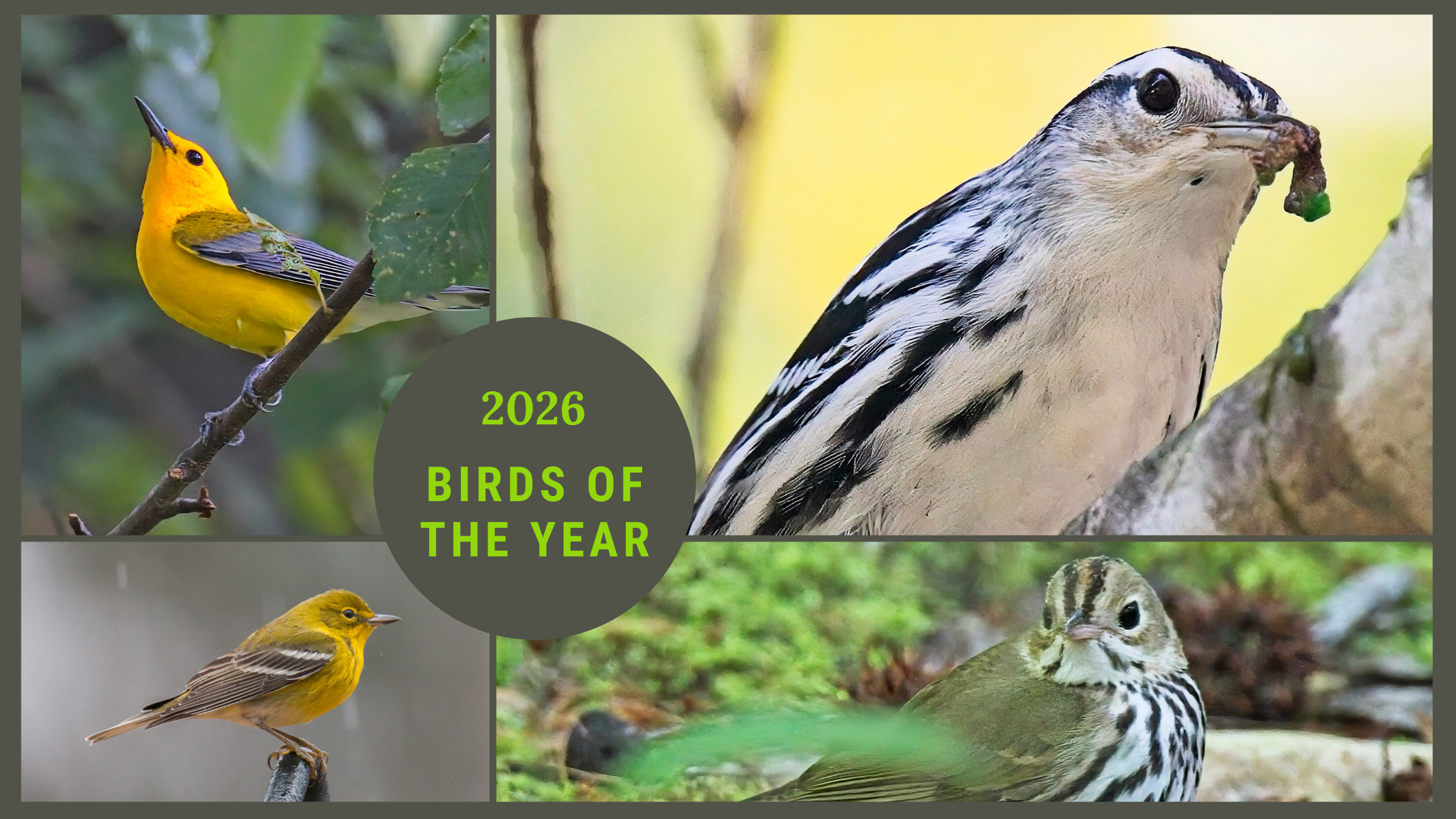
A fresh calendar replete with untrodden days. In that spirit of new-year abundance, Wake Audubon Society introduces our Birds – plural! – of the Year. Not just one, but four, New World warblers, a fitting choice from a plentiful family of about 120 species encompassing not only warblers, but also waterthrushes, yellowthroats, whitestarts, a redstart, and two parulas, who give the family its name: Parulidae. As we traverse 2026 together, we will learn about four species that call North Carolina home for at least part of their year: the Black-and-white Warbler, Prothonotary Warbler, the Ovenbird, and the Pine Warbler.
As is often the case, the taxonomical history is a tad messy, complicated by earlier confusions and conflations, and since clarified by modern science. The Old and New World warbler families are not closely related, but the New World species were so named because of their seeming similarities to the familiar small, insect-eating songbirds of Europe. As a result, the New World warblers are a misnomer twice over: not only are they not linked in an evolutionary sense to the Old World group, but they also do not share the Old World’s lilting, warbling song, their own vocalizations being more buzzy, repetitive, and rhythmic.
After a major genetic study in 2010, scientists reshuffled which species belonged to which genus within the New World family, and other recent taxonomic updates have moved some birds long treated as warblers, such as several of the chats, out of the warbler family and into other known families or even new families of their own. But our four Birds of the Year are decidedly warblers, and together they represent an interesting cross-section of the family: three of them – the Black-and-white, Prothonotary, and Ovenbird – are the sole species in their own genus, while the Pine is part of the largest genus, sharing it with more than 30 other species, including other locally familiar birds such as the Yellow-rumped Warbler. Each genus name carries a hint of what makes that species distinctive, offering clues to the unique characteristics we will explore in greater depth over the coming months:
Genus Mniotilta: from Greek roots interpreted as “moss-plucking,” a nod to the Black-and-white Warbler’s habit of picking its way along bark and moss in search of insects. The Black-and-white Warbler breeds in forests across much of eastern and central North America, where it is a familiar migrant and summer resident, especially in mature woods, before migrating to a vast range of winter habitats from Florida to South America. It wears bold black-and-white striped plumage and creeps along trunks and branches like a nuthatch, probing for insects and spiders. In the North Carolina Piedmont, this species is most common in forested western counties and is rare or absent in heavily developed areas, with birds recorded in every month of the year but most often encountered from March through October and more rarely between November and February. This will be the first species we spotlight starting next month.
Genus Protonotaria: from Latin prothonotarius, referring to Roman Catholic clerks (“prothonotaries”) who wore bright yellow robes, a reference to the Prothonotary Warbler’s rich golden plumage. The Prothonotary Warbler breeds in wooded swamps from the Mid-Atlantic and Great Lakes region through the Southeast, then migrates to spend the winter in tropical mangrove swamps. Small and striking, it shows a bright yellow head and underparts with an olive back and blue-gray wings and tail, and it forages for insects in the understory, nesting in cavities usually near standing water. In North Carolina, it is a breeding bird along quiet rivers, lakes, creeks, and swamps, generally present from April through late August or early September. We will spend the spring months learning more about this brilliant bird.
Genus Seiurus: combines Greek roots meaning “to shake” and “tail,” which fittingly describes the Ovenbird’s habit of flicking its tail, slowly while at rest and quickly when alarmed. The Ovenbird breeds in mature deciduous and mixed forests across much of Canada and the eastern United States, then migrates to wintering grounds in the southeastern US, the Caribbean, Mexico, and Central America. Olive-brown above and spotted below like a small thrush, it walks the forest floor, flipping its tail and delivering its loud teacher, teacher, teacher song from branches above. In our piedmont, it is a common breeding bird of larger forest tracts, most often encountered from April through early October. Our summer posts will explore this species.
Genus Setophaga: from Greek roots meaning “moth eater,” reflecting the insect-hunting habits of many species in the group. The Pine Warbler lives up to its name, breeding in pine forests across the eastern United States and southern Canada and, unlike many of its relatives, mostly remaining in the southern United States for the winter as a short-distance migrant. Yellowish with an olive back, pale belly, and two white wingbars, it moves more slowly than many warblers as it forages in pines for insects and seeds, and it is one of the few warblers that regularly visits bird feeders. It is North Carolina’s only truly resident warbler, commonly nesting in pine forests and remaining present through the winter, when local birds mix with additional Pine Warblers that have moved in from farther north. Fittingly, we’ll end the year with our winter warbler.
Our four Birds of the Year offer four opportunities to learn, four invitations to explore, and four ways to connect with our natural world and feathered neighbors. We look forward to sharing another year-long adventure together.
All photo credits: Robert Oberfelder
Blog post written by Wake Audubon Volunteer, Brittany Richards