


Among the Bark and Branches: Black-and-white Warblers Return
Winter loosens its grip and spring edges closer. Warmer days, brighter sun, livelier birdsong all signal a restless world in transition: northbound birds departing, species from the south arriving. As we wrap up our monthly spotlights on Black-and-white Warblers, we also welcome them home to their breeding grounds. A perfect opportunity to learn how to spot their stripes in our summer canopy, and to learn about the families they’ll soon be raising on our forest floors.
Black-and-white Warblers are among the earliest migrants to return each spring, and will begin appearing in North Carolina by the end of March. Since they forage on bark, they can migrate earlier than other species because they don’t have to wait for leaves to emerge and instead can pluck overwintering insects from crevices along the trunk and branches. Although they migrate widely through the Piedmont in the spring, they rarely stay to nest, and in Wake County they are now essentially absent as a breeding species. Instead, their true summer home lies mostly to our west, where they are common in the mountains, with additional nesting pockets in the Coastal Plain. So while they might pass through a local backyard during migration, these warblers are birds of forests rather than feeders, making a summer trip to our western woods the best chance to find one. Look for them in established deciduous forests in the mountains and foothills, and bottomlands and swamps in the Coastal Plain, where mature hardwood forests are scarce.
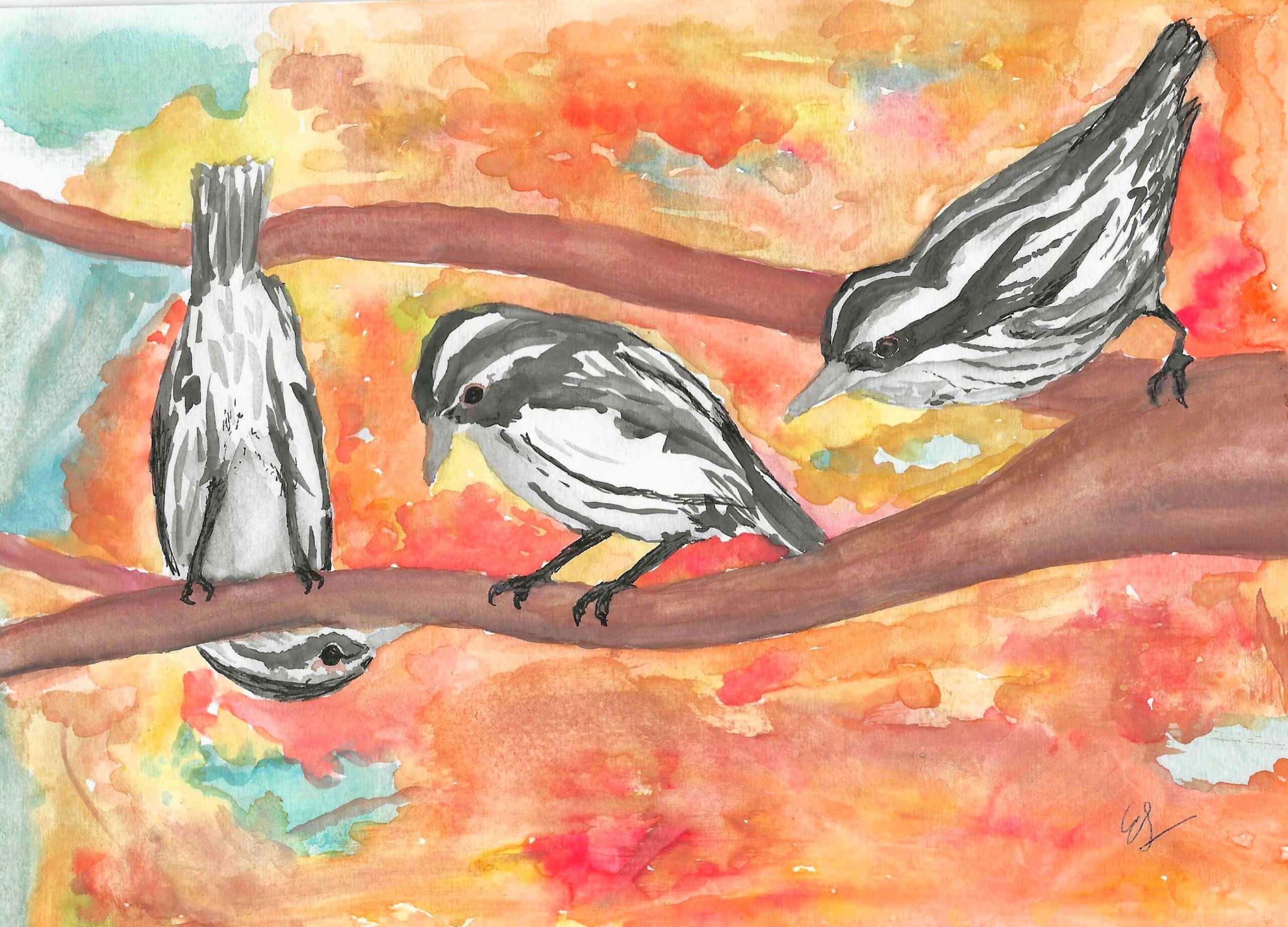
The Black-and-white Warbler looks just as its name promises: crisp zebra striping from crown to tail, as if someone sketched a forest bird using only ink and paper. Males in breeding season show bolder black on the cheek and throat, while females wear a very similar pattern, just slightly more muted with a whiter throat and grayish ear patch. Their song, thin, squeaky, and persistent, is often compared to a squeaky wheel or wheelbarrow, or like the turning of a rusty auger.
But even more than sight and sound, their distinct movement might make them easiest to spot. Unlike most warblers that flick through leaves, Black-and-white Warblers creep along trunks and larger limbs like a nuthatch, probing bark with a slightly down-curved bill and gripping with unusually long hind claws. They move methodically up, down, and around branches, sometimes even hanging upside down beneath them.
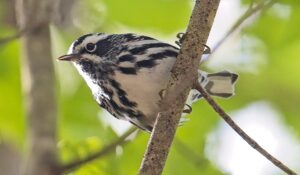
That behavior also distinguishes them from species they could be confused with. Of other common bark-foraging birds, woodpeckers hitch straight up, nuthatches walk downward, and creepers spiral upward, while Black-and-white Warblers distinctly wander freely in every direction around the bark. And they are the only ones marked in crisp black-and-white stripes rather than the mottled patterns of Brown Creepers or the spots or bars many woodpeckers sport in addition to stripes.
Among warblers, a possible point of confusion could be the Blackpoll in spring, when male Blackpolls also wear black and white. For a brief window in late April and May the two warbler species can share the same woods in North Carolina: Black-and-whites settling in to breed while Blackpolls pass through on their way much farther north. But they occupy different layers of the forest. Black-and-whites circle bark and large limbs; Blackpolls remain in the leafy canopy. Blackpolls also lack the dramatic stripes of the Black-and-white, and instead males have prominent black caps, white cheeks, and striped sides. (And note: while the two species might again overlap in North Carolina from late September to late October during the Blackpoll’s fall migration, its fall plumage is so different from its spring plumage that it would be more likely to be confused with a nonbreeding American Goldfinch than a Black-and-white Warbler!)
Despite spending most of their time in trees, Black-and-white Warblers raise their young on the ground. Males arrive on breeding grounds first to claim territories and find a mate. Black-and-white Warblers form seasonal pair bonds, meaning they are monogamous for the breeding season. Their courtship is energetic and prolonged: the male pursues a female through the trees with persistent song and flashing plumage before settling beside her with fluttering wings. The female builds a cup nest around 5 inches in diameter and 5 inches high on or near the ground, usually tucked against a tree base or fallen log and camouflaged under leaves, weaving it from leaves and coarse grasses and lining it with softer materials. She lays four to six speckled white eggs and alone incubates them for about ten to twelve days, while the male occasionally brings food and guards the territory. After hatching, both parents feed and defend the young, which leave the nest about eight to twelve days later but stay nearby for several more weeks as they learn to forage. Most pairs raise a single brood each season, though a second is occasionally attempted. Because their nursery sits in the leaf litter while the adults forage the trunks above, their breeding season is easy to overlook, the forest holding a hidden second layer of life beneath the singing trees.
With territories established and nests resting beneath the leaves, the Black-and-white Warbler shifts from migrant to resident. In our next installment we’ll move from upland forests to flooded woods and swamps to meet another summer visitor: the Prothonotary Warbler.
Blog post written by Brittany Richards, WAS Volunteer
Original watercolor by Evan Landon (reference photographs courtesy of Shannon Schlater)
Photo by Robert Oberfelder