


A Spring Production: Inside the Breeding Life of the Prothonotary Warbler
The windows overlooking my yard offer a springtime show of cinematic proportions.
For weeks, I’ve been transfixed by a rotating lineup of performances, each drawn from a different genre. Drama: a suspenseful standoff between Carolina Chickadees and Eastern Bluebirds vying for a coveted nest box (the chickadees victorious this year). Tragedy: a cardinal pair returning to an empty nest, their three eggs gone, likely lost to something hungry, just days before they would have hatched. Comedy: an uncoordinated but endearing Brown Thrasher fledgling, all loose limbs and uncertain wings, bumbling through the underbrush. This seasonal surge of activity is one of nature’s most captivating productions. And now, the Prothonotary Warblers join the cast, their story unfolding in the flooded forests they call home.
Prothonotary Warblers are rare among warblers, as they are the only species of eastern North American warblers that nest in cavities, using holes created by woodpeckers and chickadees, natural cavities in standing dead trees, and readily accepting nest boxes. Typically located near or over standing water in trees such as bald cypress, willow, and sweetgum, their nests may be placed anywhere from a few feet to over 30 feet above the ground.
For Prothonotary Warblers, courtship begins before the pair even meets. Males arrive first on the breeding grounds, up to a week before females. This pattern of early-arriving males, known as protandry, is common among migratory songbirds and allows males to begin claiming territory to attract a mate. Once they’ve arrived, the males set to work finding cavities, tucking bits of moss into multiple hollows and creating several potential nest sites. Preparation that is part construction, part display. When females arrive, they evaluate these territories and cavities as part of mate selection, assessing not only the habitat but also the male’s effort and investment.
After establishing a territory and preparing several cavities, the male then attracts a female at these sites by using both movement and repetition to draw her attention. As the Cornell Lab describes, “He flies slowly up above the tree canopy with tail spread and slowly flutters back down. To entice the female to check out potential nesting sites, he enters and exits the hole several times.” Once the female selects her preferred cavity, she alone begins building the nest using more moss, rootlets, plant fibers, cypress bark, and lining it with grasses, leaves, and even vine tendrils such as poison ivy. The nest itself is compact, with a cup roughly two inches across, tucked within a cavity entrance of similar size, and is typically completed in less than a week.
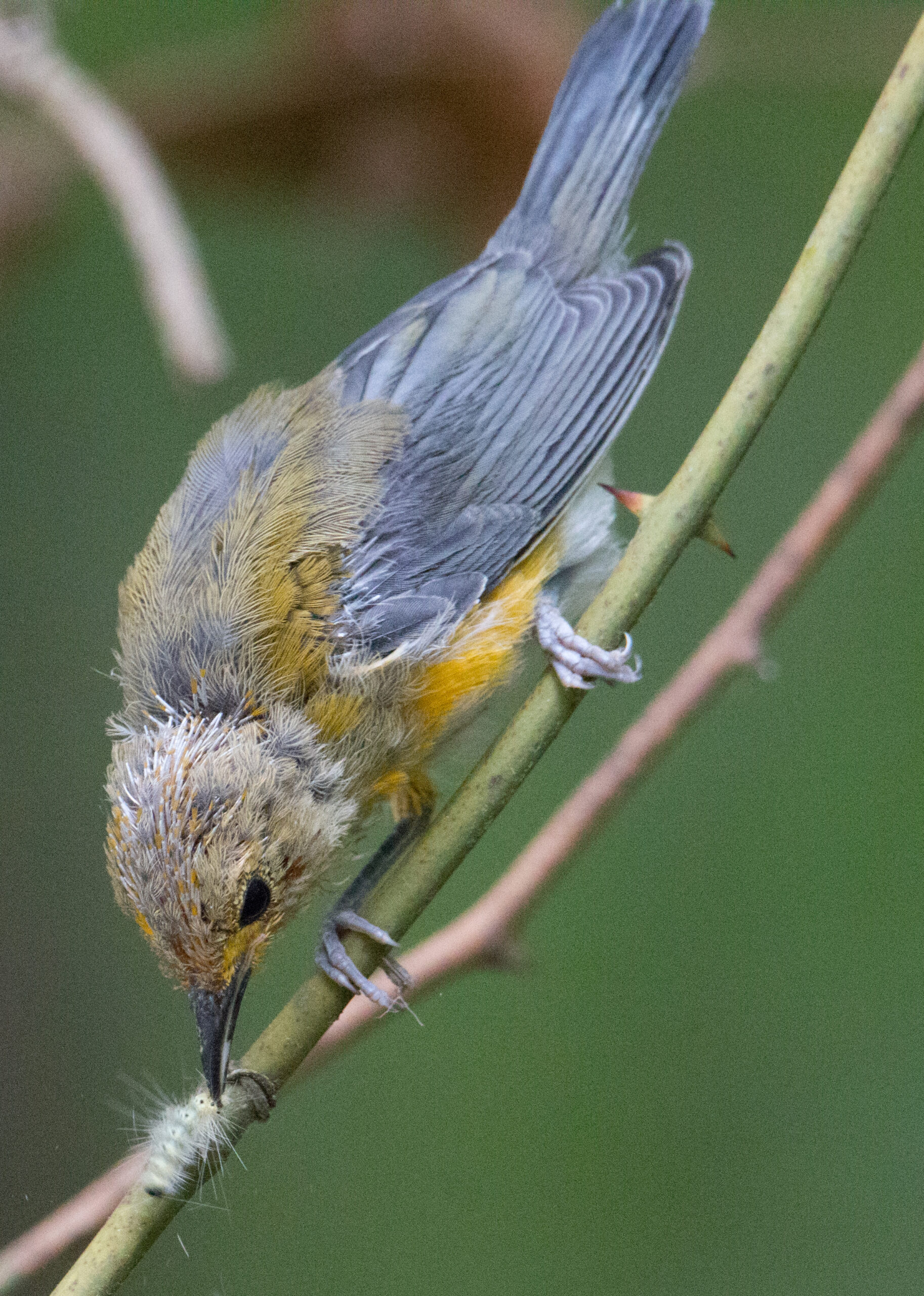
Clutch size generally ranges from 3-7 eggs, which are white with brown to lavender spotting. Incubation lasts about 12-14 days, and nestlings remain in the cavity for roughly 9-10 days before fledging. At hatching, the chicks are altricial, meaning helpless, with eyes closed, and only sparsely covered in down. While only the female is responsible for incubation and develops a brood patch for the task, both adults contribute heavily to feeding once the chicks hatch. Nestlings are fed almost exclusively insects and other small invertebrates, including caterpillars, spiders, mayflies, grasshoppers, and beetle larvae. Both parents feed the chicks, making frequent trips to the cavity with food, and they also remove fecal sacs to keep the nest clean. After fledging, parental care continues for up to a month, with adults feeding and tending to the young as they remain nearby and gradually learn to forage on their own. Parents will split the brood, with each adult tending different young; however, if the female begins a second nest, the male takes over care of all fledglings from the first brood.
In North Carolina and throughout the southern portion of their summer range, two broods are common. Per the North Carolina Wildlife Resources Commission, the breeding timeline for Prothonotaries is generally: “Courting begins after they arrive in late March and early April,…[t]he first brood appears in early May, and the second in late June….leaving around August to return to their winter grounds in Central and South America.” Prothonotary Warblers are seasonally monogamous but may re-pair in subsequent years and may return to the same breeding sites, especially after successful nesting.
During the breeding season, both members of the pair defend their territory aggressively, chasing intruders and sometimes engaging in physical attacks. A wide range of predators target Prothonotary Warbler nests. Eggs and nestlings are especially vulnerable to snakes, particularly rat snakes, as well as raccoons. In some parts of their range, House Wrens and red squirrels also raid nests, and smaller mammals like mice and flying squirrels have been documented doing the same. Other likely nest predators include weasels, mink, and gray squirrels. Even after fledging, danger remains: Blue Jays may take newly fledged young, and in nests directly above water, chicks that fall may occasionally be eaten by large fish such as bass.
Prothonotary Warblers are also frequent hosts of Brown-headed Cowbirds. The likelihood of parasitism varies widely from place to place and year to year, but in some studies, about 10% of monitored nests were parasitized, while others have found rates closer to 25%, suggesting that in certain areas, cowbird pressure can be a significant part of the breeding story.
This busy season unfolds for Prothonotary Warblers as a familiar three-act play: courtship, construction, care. A story that repeats each spring, with new players but familiar roles. Next month, we’ll step back from the hidden interior of the nest and focus instead on how to find and identify Prothonotary Warblers in the field.
Blog post written by Brittany Richards
Juvenile Prothonotary Warbler photo credits: Robert Oberfelder