A Field Guide to Spring’s Brightest Warbler
If the symphony of songs wafting through our yards or the frequency of freckled fledglings at our bird feeders aren’t enough to confirm that breeding season is in full swing, then the vivid seasonal plumage on view makes it clear that summer courtship is underway. The prismatic display spans the full spectrum, but perhaps the most eye-catching colors are the nearly neon summer yellows. Gilded goldfinches are some of the flashiest backyard visitors. But if we venture a bit further afield, on a walk through the woods or a field trip to a flooded forest, we can find Prothonotary Warblers in an equally dazzling saffron suit.
The key to finding Prothonotaries is to seek out somewhere wet and wooded. They prefer large tracts of mature trees suitable for nesting cavities, including flooded forests, swamp edges, wooded creeks, bottomland hardwoods, cypress-tupelo swamps, and shady lakeshores. Look for areas with slow-moving or standing water. Because they tend to avoid smaller forest fragments, those of us in urban and suburban areas will likely need to venture out, as Prothonotaries “tend to avoid forest patches smaller than about 250 acres or forest borders less than 100 feet wide.” In the Triangle, sightings on iNaturalist suggest the Haw River, Jordan Lake, and Mason Farm Biological Reserve offer good odds of spotting Prothonotaries. While fairly common in the Piedmont, they become more numerous moving east and rarer moving west.
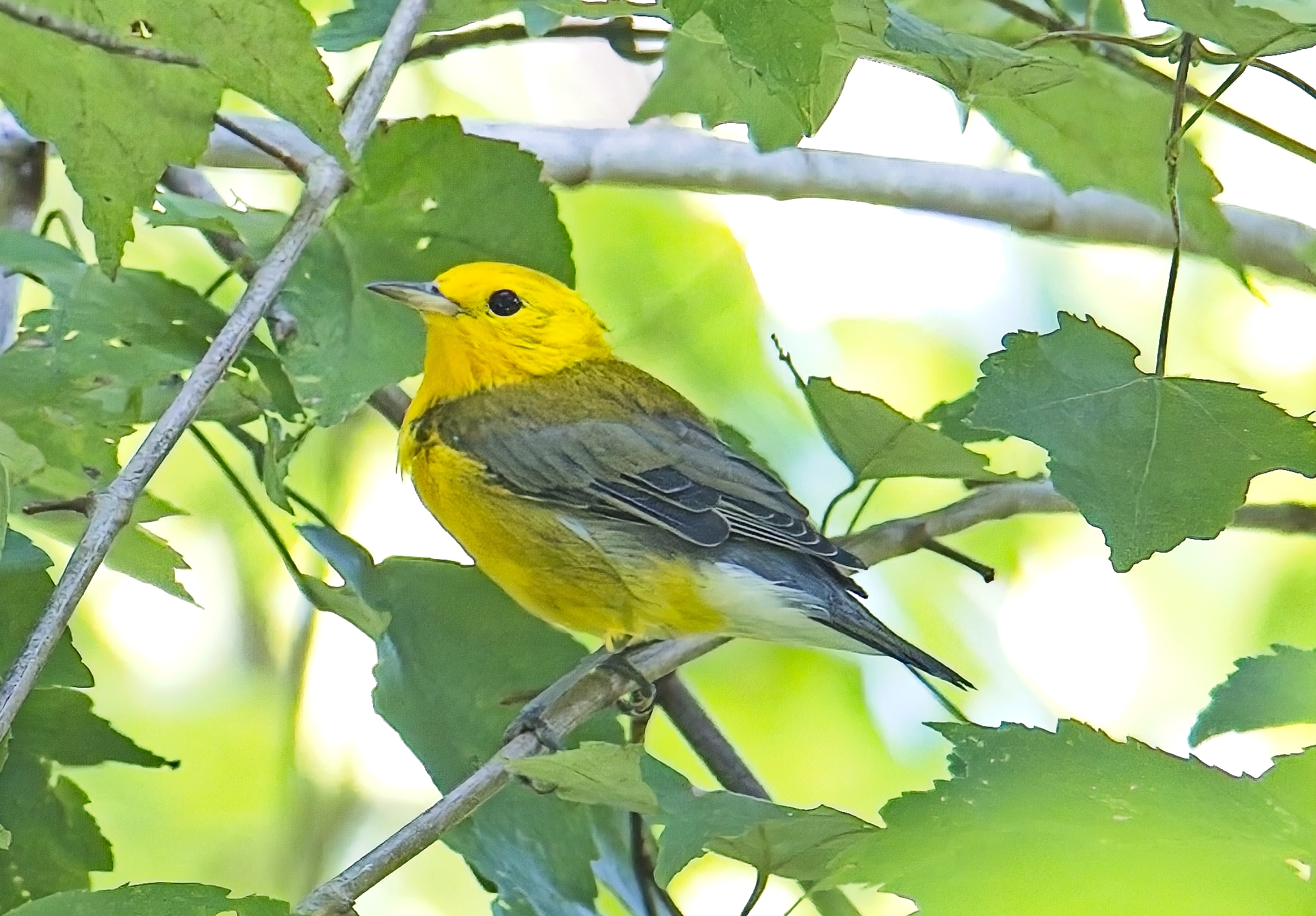
Once you have found suitable habitat, look low, where Prothonotaries forage along branches over water, often hopping in the shadowy understory, their bright yellow plumage standing out dramatically. Prothonotary Warblers are medium-sized for a warbler, slightly larger and more compact than many others, with a thick body, shorter tail, and relatively large head and bill. They are among the brightest yellow birds in eastern forests, with a rich yellow head and body, olive back, blue-gray wings without wing bars, and a clean, unmarked face with a prominent dark eye. From below, the tail appears mostly white with darker tips. Females look very similar to males but are slightly duller, with a greenish tint. Young birds resemble the adults of their sex, with overall softer, less vivid coloring.
With a clear, loud song, Prothonotaries are often heard before they are seen. The male’s song is a ringing series of “tweet-tweet-tweet” notes delivered in a steady rhythm, often from a high perch, especially in the early morning. Both sexes give a sharp “tschip” call, with a higher, rapid trill sometimes used in response to threats.
For those of us lucky enough to live near their preferred habitat, we can also increase our odds of spotting one by enticing a breeding pair with an appropriately placed nest box. While not currently considered threatened, Prothonotary Warbler numbers have declined over time, and habitat loss and degradation remain concerns. As the only warbler in our region that nests in cavities, Prothonotaries readily use nest boxes, and conservation programs that install boxes with predator guards have successfully increased local populations. The South Carolina Wildlife Federation has launched a program to install boxes throughout the Catawba-Wateree watershed, which extends into North Carolina. They describe proper nest box placement: “Prothonotary Warblers prefer low-lying areas that are easily flooded. Nest boxes should be placed in a shady area with an open understory and located within 16 feet of or directly over standing or slow-moving water. Boxes are placed on a metal pole, with the bottom of the box about 5 feet off the ground. Conical shields are installed below the mount to protect eggs and chicks from climbing predators such as raccoons and snakes.” The Cornell Lab also provides detailed guidance on building and placing nest boxes for Prothonotaries.
This spring, we’ve explored the Prothonotary Warbler from arrival to nesting to identification in the field. As the season shifts into summer, we turn to a different kind of warbler. Over the next three months, we’ll look down instead of up, following the Ovenbird along the forest floor.
Blog post by Brittany Richards
Photo credits: Brittany Richards