


Close to Home: The Pine Warbler
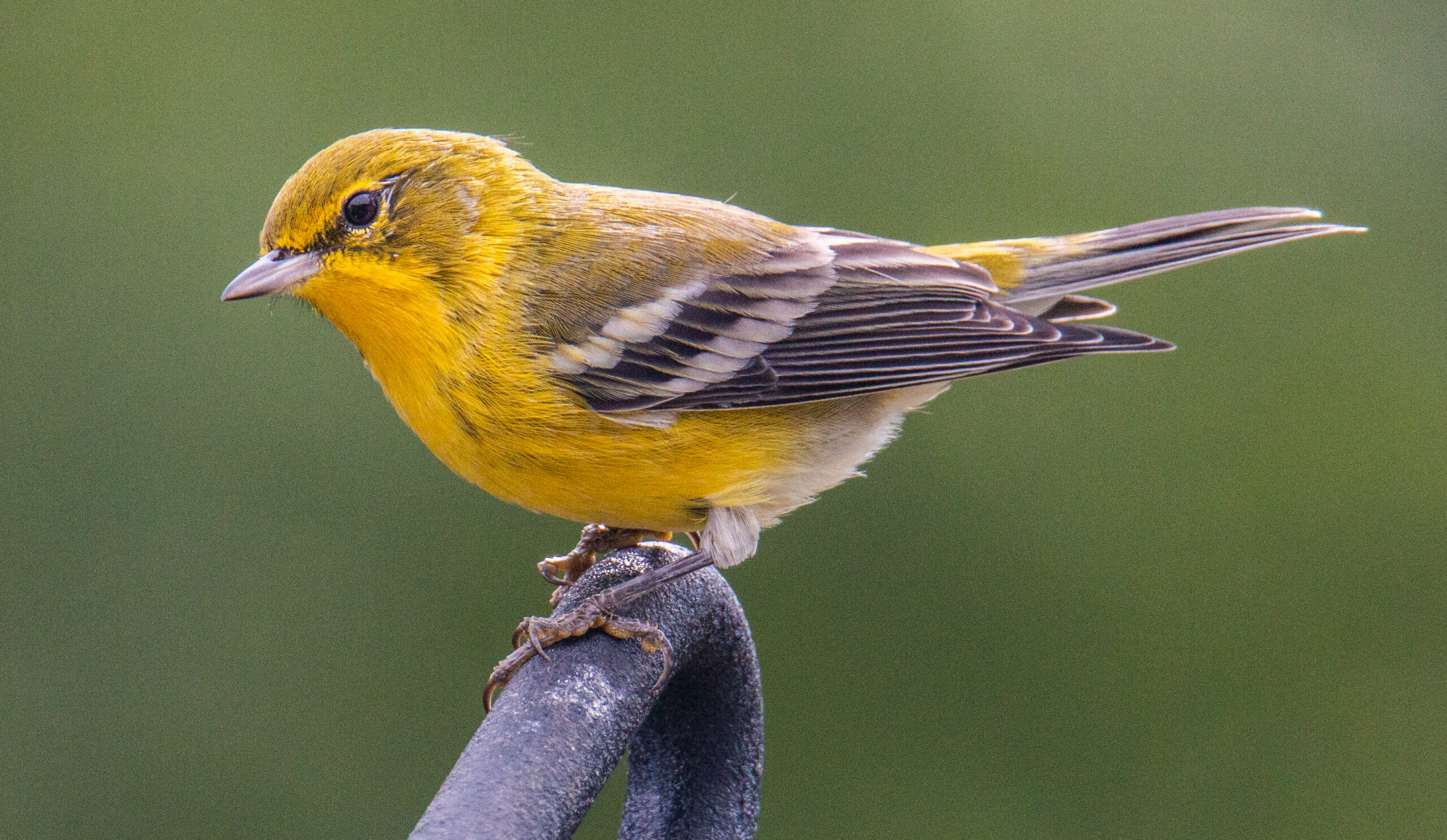
Those of us who know the thrill of spotting an elusive bird in its natural wilds experience the exhilaration of the special and fleeting. Those of us who know the fondness of watching a familiar bird frequent our feeders experience the comfort of the common and constant. What’s rare might be precious, but no less so, the ordinary can also be beloved.
Our three previous warblers – the Black-and-white, Prothonotary, and Ovenbird – inhabit relatively private worlds while visiting North Carolina during their breeding season. If not seeking them out or exploring their forested terrains, city and suburban dwellers are unlikely to encounter these species. But our last warbler highlighted this year, the Pine Warbler, lives among our human habitations, the proximity giving us the opportunity to become personally acquainted.
As the Cornell Lab puts it: “Perhaps no bird species is more characteristic of the pine forests of eastern North America than the Pine Warbler.” Aptly named, the Pine Warbler is found almost exclusively and abundantly in pine trees, and can be found in almost any stand of mature pines, from large pine plantations to residential neighborhoods and golf courses. They are not particular about the type of pine, and in the North Carolina Piedmont, they are readily found in our common pines, including the shortleaf, loblolly, and Virginia. They are the dominant breeding species to nest in our pines and one of the more plentiful songbirds.
The Pine Warbler is distinct from our other 2026 Birds of the Year in a variety of ways. They are a familiar sight at our fall and winter backyard feeders – a fact that already distinguishes them from their warbler brethren – because among the insectivorous warblers, they are unusual for having a seasonal diet that so regularly includes seeds and fruit. In the warmer months, when their preferred arthropod food source is plentiful, they live up to their genus name, Setophaga, meaning moth eater. Studies have shown that while they consume a wide variety of insects and arachnids, a quarter to a third of their diet is moths and caterpillars.
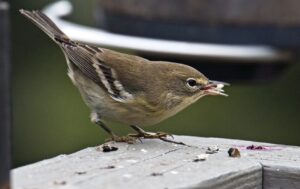
The fact that they are still in the United States at all come winter is also remarkable. Whereas our other warblers leave for the Caribbean, Mexico, and Central and South America in the nonbreeding season, the Pine Warbler is a year-round resident in North Carolina and the Southeast. Of our four warblers of the year, the Pine’s range is the most compact, confined almost entirely to eastern North America. In the breeding season, they extend as far north as southernmost Canada and the Great Lakes and as far west as eastern Texas, and come winter, these migrants join the permanent residents who live all year in the southeastern states.
In the remaining posts over the next two months, as we wrap up our year of the warblers, we will learn more about the characteristics and qualities that distinguish the Pine Warbler from our other birds of the year. Familiarity hopefully breeding appreciation!
Photo credits: Robert Oberfelder and Brittany Richards
Blog post written by Brittany Richards