


The Warbler That Stays
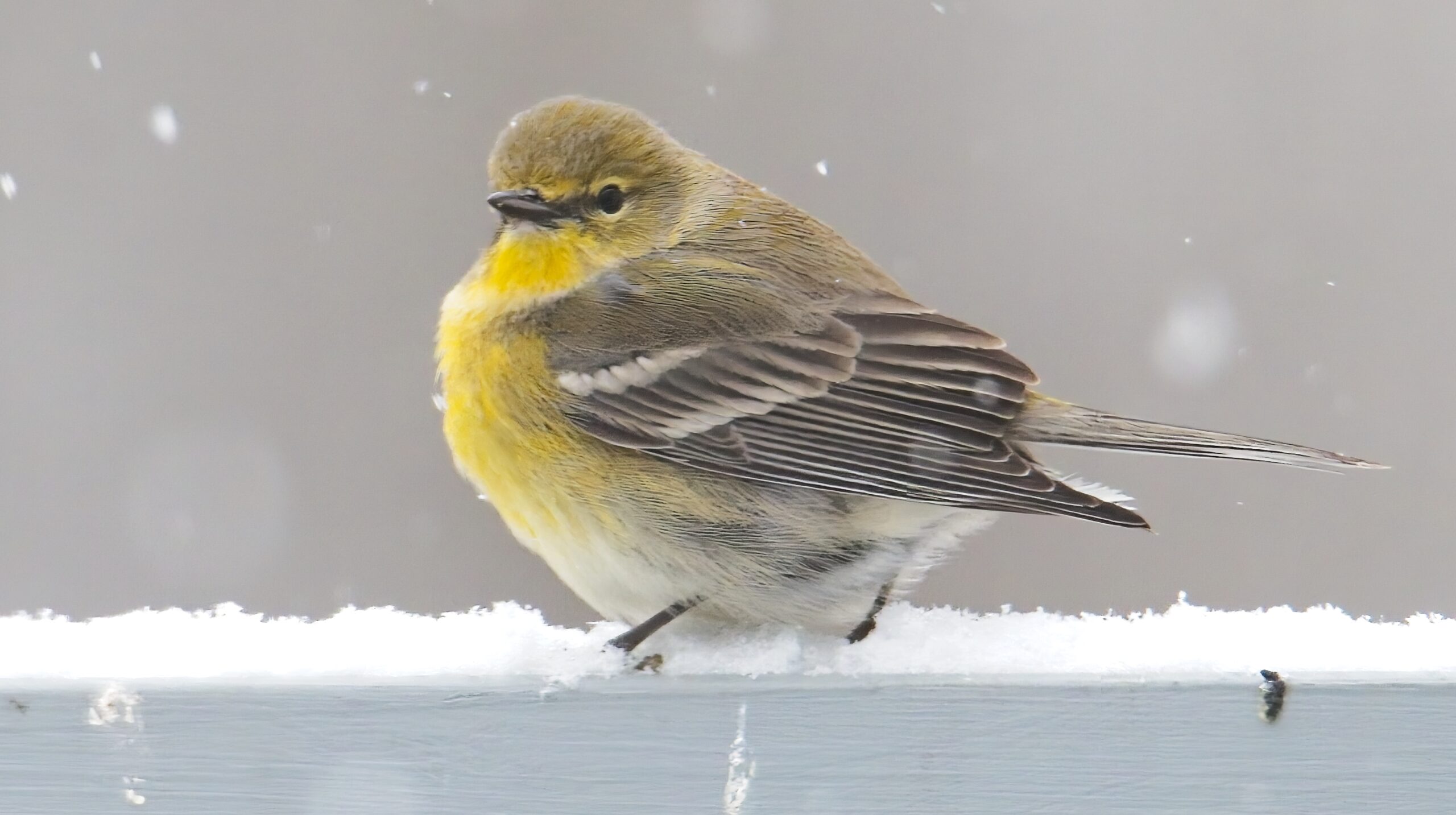
Fall is a season in flux. March may get the pithy proverb about lions and lambs, but October is equally a month of contrasts. Early days that can make it feel as though summer continues unabated transition into chilly days that make it clear a transformation is underway. A veritable river of birds in our nighttime skies brings old winter friends arriving from the north, as our summer visitors join the migratory stream flowing south. Our resident Pine Warblers are with us all year, but they too change with the season, albeit in subtler and less typical ways.
Unlike most warblers, Pine Warblers are largely sedentary, although their migratory habits vary among populations. Three subspecies, those found in Florida and the Caribbean, are believed to remain in their respective ranges year-round. But the fourth subspecies, the one that lives throughout much of the eastern United States, includes both resident and migratory populations. Pine Warblers remain in North Carolina all year, but those breeding north of southern Tennessee and Virginia, into the Northeast and Great Lakes region, migrate south for the winter. There, they mingle with permanent residents, making it difficult to distinguish the migrants. This overlap also complicates efforts to determine the southern extent of their winter range, the exact timing of their fall migration, and whether some southeastern populations might migrate short distances themselves.
Pine Warblers also change their social habits with the seasons. In spring and summer, they are generally found in pairs, and later, in small family groups. By fall and winter, they may join mixed-species foraging flocks that can include Carolina Chickadees, Tufted Titmice, woodpeckers, Brown-headed Nuthatches, Eastern Bluebirds, kinglets, Yellow-rumped Warblers, Chipping Sparrows, Blue-gray Gnatcatchers, Blue-headed Vireos, and other warblers.
Their seasonal plumage changes as well, though less dramatically than that of many other songbirds. Pine Warblers are small and yellow, with olive backs, subtly olive-streaked chests, yellow throats, and paler bellies. Their gray wings feature two white wing bars, and their eyes are framed by broken eye rings, usually yellower in males and whiter in females. Their bills are dark, stout, and pointed. Females are plainer overall, with their yellow more confined to their face and throat. In fall, males become slightly duller, while females can be considerably drabber. Immature birds vary from gray to pale yellow with white eye rings, and females in particular can be almost entirely gray. Young birds of both sexes remain duller and browner in their first fall.
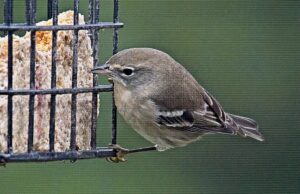
Pine Warblers can resemble several other yellowish warblers, depending on age, sex, and season, including Blackpoll, Bay-breasted, and Cape May warblers. But for those hoping to spot a Pine Warbler in their Piedmont yard in winter, perhaps the most likely source of confusion is the American Goldfinch. In summer, when the male Goldfinch’s breeding plumage presents a striking contrast of black and gold, there is little chance of mistaking the two. Especially when Pine Warblers spend those months foraging in pine forests rather than visiting feeders. Come winter, however, the Goldfinch sheds its brilliant breeding colors for a considerably more modest appearance, and the two species share both a resemblance and a habit of visiting feeders for seeds. Their similar size, yellowish coloring, and wing bars can make them possible to confuse, especially at a distance. The most telling difference is the bill. The American Goldfinch has a short, thick, conical bill adapted for cracking seeds, while the Pine Warbler’s is more elongated and pointed, suited to gleaning insects from bark and foliage. Upon closer examination, the Pine Warbler also has a relatively longer tail and noticeable eye rings. To attract Pine Warblers in fall and winter and put your identification skills to the test, offer familiar feeder favorites such as millet, cracked corn, sunflower seeds, peanuts, and suet, as well as mealworms.
As autumn gives way to winter, the Pine Warblers that remain among us offer a welcome continuity in an otherwise changing landscape. Next month, we’ll conclude our exploration of this year-round resident and, with it, our yearlong spotlight on the remarkable diversity of warblers that inhabit and pass through North Carolina.
Want the final Pine Warbler post and more stories like this delivered to your inbox? Sign up for the Wake Audubon newsletter.
Photo credits: Robert Oberfelder
Blog post written by Brittany Richards