Life in the Leaf Litter: Meet the Ovenbird
“Four and twenty blackbirds baked in a pie…” Our newest bird of the month might call to mind that familiar nursery rhyme, conjuring images of birds destined for pastry.
But the Ovenbird’s unique name has nothing to do with its culinary potential. Over the next three months, we’ll take a closer look at our next warbler, exploring how it lives, breeds, and how to spot it among the leaf litter of our summer woods.
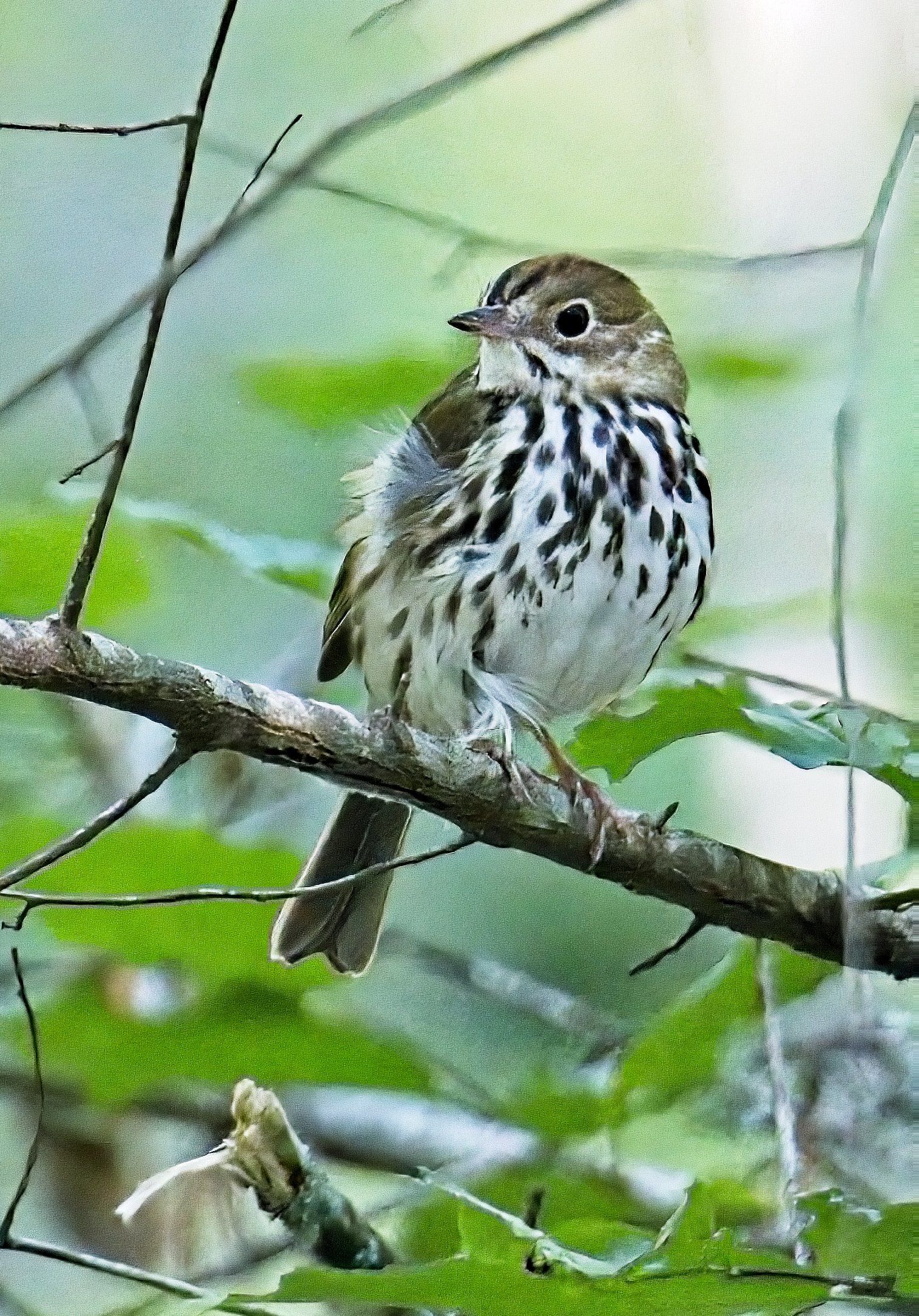
The Ovenbird was first described scientifically in the 1700s, when early naturalists referred to it as the “Golden-crowned Thrush,” a name that persisted well into the next century. Even though Scottish-American ornithologist Alexander Wilson wrote in 1810 the name may not have been entirely apt: “THO the epithet golden crowned, is not very suitable for this bird, that part of the head being rather of a brownish orange; yet, to avoid confusion, I have retained it.” Fair enough, the crown is more a subdued rust, and the bird itself is better recognized by its olive-brown back, boldly streaked chest, and crisp white eye-ring.
The Oxford English Dictionary records the earliest known use of “Ovenbird” in 1789, suggesting it first emerged as a colloquial description rather than a scientific one. By 1832, Thomas Nuttall used both names in his A Manual of the Ornithology of the United States and of Canada, writing of the “Golden-crowned Thrush, or Oven-bird” and noting that “its curious oven-shaped nest is known to all the sportsmen who traverse the solitary wilds which it inhabits.” That nest remains the key to the name we know today: a small, distinctive, domed nest shaped like a tiny outdoor oven and tucked carefully into the forest floor.
In North Carolina, Ovenbirds arrive in April and remain through early October, returning from wintering grounds that stretch from the Yucatán and Central America through the Caribbean and into Florida. Across their non-breeding range, their habitat is fairly diverse: “They avoid open fields and cultivated areas, but where mature forests are unavailable, they can live and feed among shade coffee trees or mangroves, on dry scrubland or regenerating agricultural land, and in moist upland or dry lowland forests.” During the breeding season, Ovenbirds prefer the forest interior, favoring large, continuous tracts of mature woodland. They are found across much of eastern North America, from the northern edge of the Southeast through the Mid-Atlantic and Great Lakes and into Canada, and are a common summer resident throughout North Carolina. Regardless of location, their habitat needs are fairly consistent: a canopy of tall trees that shades out dense undergrowth and allows for the deep leaf litter they depend on.
That same leaf litter also shapes the Ovenbird’s diet. In both breeding and wintering areas, they spend much of their time on the forest floor, foraging among leaves for insects like beetles, flies, caterpillars, and other larvae. On their wintering grounds, their diet is more flexible, adding seeds or focusing on locally abundant prey like ants, and sometimes foraging in grasses or mud.
Ovenbirds are particularly well adapted to a narrow ecological niche, allowing them to share the forest with similar species without direct competition. They do this in part through how they feed. Ovenbirds focus on the leaf litter itself, picking prey as they move steadily across the forest floor. Other species employ slightly different tactics: the Kentucky Warbler tends to feed just above that layer, gleaning insects from living leaves and vegetation, while Swainson’s Warbler more often flips through the leaf litter to uncover beetles and spiders. This separation extends beyond feeding behavior to the landscape itself. In large forests, Ovenbirds are most often found on moderate slopes, while the Louisiana Waterthrush and Kentucky Warbler prefer low-lying areas, and the Worm-eating Warbler favors steeper slopes. Together, these small differences in diet and habitat allow multiple species to occupy the same woods without competing for the same resources.
The Ovenbird’s story is, in many ways, a story of the forest floor. That becomes especially clear during the breeding season, when their habitat becomes not just a place to forage, but a place to build. Next month, we’ll take a closer look at the Ovenbird’s most distinctive feature: its remarkable nest, and the breeding behavior that gives the species its name.
Photo credits: Robert Oberfelder
Blog post written by WAS volunteer, Brittany Richards