
Look and Listen: Finding the Ovenbird
As much as I wish the rhythms and routines of my life allowed for as much time spent in nature as possible, my birding habits of late are decidedly more watching out the window than walking through the woods. Which is why a recent moment of true serendipity occasioned such glee.
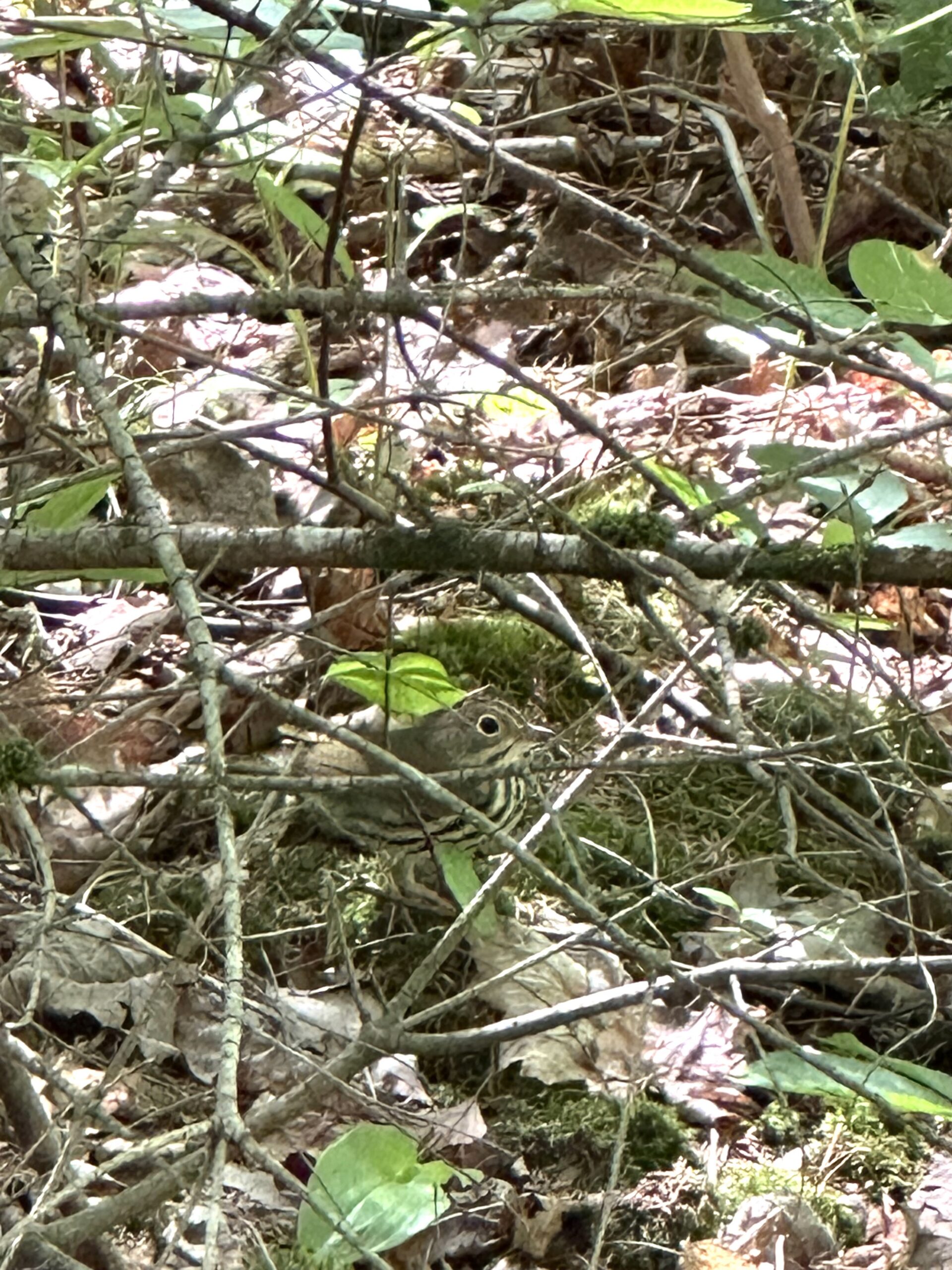
While exploring forested trails in Maine on a family vacation, my ears trained on crunching in the leaves or calls from the canopy, a rustle caught my attention. As I located the small speckled culprit, I was delighted to recognize an Ovenbird! The very subject of our monthly spotlights this summer. And even more fortuitously, field identification is the focus of this post.
Any avid birdwatcher knows the joy, no matter how common the species, of notching a new addition to your life list. Now that I’ve added the Ovenbird to mine, I hope to help you add it to yours as well. My sighting was precisely where you would expect to find an Ovenbird: in a large, mature forest and underfoot amongst the leaf litter. At first glance, an Ovenbird could be confused with other familiar species with dappled or streaky breasts such as a Hermit Thrush or a Song Sparrow. But an Ovenbird is most easily distinguished by its prominent orange and black crown stripes (in July we learned, one early epithet was the “Golden-crowned Thrush”). Other notable field marks include its conspicuous white eyering, bold black spotted chest, and pale pink legs, with a duller olive-brown back and wings.
Ovenbirds can also be identified by their unique gait and distinct song. Described as walking “herky-jerky” with its tail held up, the Ovenbird’s purposeful striding across the forest floor called to mind for me a strutting head-bobbing chicken. Their song is distinguished for being especially loud and is usually described as a “teacher, teacher, teacher,” with the emphasis on different syllables varying geographically and among individuals. Males are especially vocal, and Ovenbirds are one of the few species to sing throughout the heat of the middle of the day, giving you a good chance to hear them in the summer woods.
While populations are steady and the species’ conservation status is “least concern,” like most birds, Ovenbirds are facing human-made threats. Because they require large tracts of contiguous forest, development and fragmentation threaten their survival. As the Cornell Lab of Ornithology puts it bluntly, “Nearly any physical disturbance to mature forest is likely to reduce [the Ovenbird’s] abundance.” But conservation is the remedy: “These negative effects can be reduced by increasing the area of undisturbed, mature forest, minimizing the amount of edge habitat and decreasing isolation.”
Like many neotropical migrants, Ovenbirds also face habitat degradation in their wintering grounds, which can include shade-grown coffee farms. As we learned when the Ruby-Throated Hummingbird was our bird of the year: “[C]offee farming practices have significant impacts on bird habitats. In particular, market pressures to clear cut native trees and plant higher-yield sun-growing coffee leads to deforestation and reduced biodiversity, imperiling both migratory birds and year-round species.” Buying bird-friendly, shade-grown coffee is one way to help preserve habitat for Ovenbirds and many migratory species, including the Black-and-white Warbler we met earlier this year.
For reasons that aren’t precisely known, Ovenbirds are also particularly susceptible to window strikes. In numerous studies, Ovenbirds have been among the most abundant species killed by strikes with commercial buildings. You can learn how to help prevent window strikes and protect migrating birds by participating in Wake Audubon’s Lights Out initiative. With fall migration beginning this month, September is the ideal time to participate.
As our Ovenbirds begin their annual fall departure, I hope you have the good fortune to see one before they are gone for the season. But as we say goodbye to the Ovenbird, in both our blog and our region, we will have our last warbler of the year to keep us company: the Pine Warbler! Not only will the Pine Warbler claim the spotlight in these posts, but as our only Bird of the Year that is a year-round resident, it will also remain a notable winter sight in our yards and pines.
Photo courtesy of the author, taken in Bangor, ME July 2026